5 CSR benefits of a corporate beehive
A corporate beehive can turn an abstract corporate social responsibility commitment into something employees can observe, discuss and share. The changing seasons, the work of a beekeeper and the eventual honey harvest provide tangible opportunities to explore a company’s relationship with the living world. Done well, the project becomes more than a rooftop feature: it creates a lasting platform for environmental education, employee participation and meaningful communication.
The key is to combine enthusiasm with sound ecological judgement and professional management. Installing managed honey bees is not, by itself, a solution to biodiversity loss, and a hive should never substitute for reducing a company’s environmental footprint. Within a broader CSR programme, however, it can deliver valuable benefits. Here are five ways a corporate beehive can contribute—and how Apiterra helps businesses build a credible, accessible and carefully managed project.
What makes a corporate beehive a credible CSR project?
Start with a purpose, not just an installation
A beehive becomes a CSR asset when the company knows what it wants the project to achieve. That might mean helping employees understand pollination, creating shared learning experiences or making an existing environmental programme more visible. A clear purpose connects the installation to everyday organisational life.
It also establishes appropriate expectations. The presence of a hive does not demonstrate that a business is sustainable overall. Its value lies in the specific activities it supports: responsible colony care, education, engagement and honest reporting. Those are concrete contributions that can be explained without making sweeping environmental claims.
Build suitability and safety into the brief
Apiterra begins with an on-site feasibility assessment conducted with the client. This gives the project a practical foundation before installation. Access, use of the surrounding space and arrangements for professional management should all be part of the conversation.
Reassurance should rest on prevention and clear responsibilities, not a promise of zero physical risk. Bees can sting, and allergic reactions are possible. Professional management, appropriate siting and clear guidance help manage these risks. If hosting a hive is unsuitable, sponsoring colonies in Apiterra’s apiaries offers a way to participate without installing bees at the workplace.
1. Make environmental awareness tangible
Give employees a window into pollination
Pollination can feel remote from office life or industrial operations. A corporate beehive offers an accessible starting point for understanding how flowering plants, insects, weather and seasonal resources interact. Employees can follow a living system rather than encounter environmental issues only through presentations.
That experience can encourage better questions: what flowers grow around the site, when are resources available, and how is outdoor space maintained? These discussions make biodiversity easier to relate to everyday decisions. The educational benefit is particularly strong when the hive becomes a starting point for looking beyond honey bees to other pollinating insects.
Connect the hive to broader habitat stewardship
Managed honey bees are only one part of the pollinator picture. Wild bees and other insects also need suitable habitat, and introducing more honey bee colonies is not automatically beneficial in every location. Local conditions and available floral resources matter.
A credible CSR programme therefore considers the wider site alongside the hive. Depending on the premises, complementary actions might include supporting diverse flowering plants, protecting nesting habitats and reviewing grounds-maintenance practices. These should be treated as distinct actions with their own objectives. The hive provides an engaging educational focus; it should not be presented as proof that all local biodiversity needs have been addressed.
2. Create opportunities for employee engagement
Build a shared experience across departments
CSR participation is easier to encourage when people have something specific to discover together. A beehive can create conversations between colleagues whose daily work rarely overlaps. Seasonal updates and organised activities provide recurring touchpoints rather than relying on a single launch event.
Apiterra offers activities at company sites or at its own apiaries. These can give employees an opportunity to explore beekeeping beyond their usual working environment. Participation should remain voluntary, with accessible alternatives for anyone who cannot or does not wish to approach bees. An inclusive project values curiosity without requiring everyone to have the same experience.
Keep the connection alive between activities
The most engaging projects continue after installation day. Apiterra’s mobile application, launched in 2020, supports monitoring and care, while real-time Apinews information notes make beekeeping updates available to all employees. These channels help maintain a connection with the project between in-person moments.
Companies can incorporate those updates into internal communications and invite employees to submit questions. Deeper learning is also possible through Apiterra’s comprehensive training at its Montreuil premises and its Api week-end offering. Engagement should be assessed through participation and feedback, rather than assuming that a hive automatically improves morale or staff retention.
3. Give CSR communication a concrete foundation
Tell a specific story that people can follow
Environmental communication is more convincing when it describes real activity. A corporate beehive provides a sequence of understandable moments: assessing the site, installing the hive, following professional visits, learning about colony care and discovering the harvest. Each offers an opportunity to explain what the company is doing and why.
Apiterra provides personalisation options including a roll-up banner, roof sticker, customised apiary sign, communication pack, Dibond panel and totem. These materials can make the project visible and explain its purpose. Their strongest role is educational: helping employees and visitors understand the initiative rather than simply adding branding to an installation.
Keep environmental claims proportionate
A useful communication rule is to describe the action before claiming an outcome. Saying that a company hosts a professionally managed hive and provides employee learning opportunities is specific. Claiming that the installation saves biodiversity, offsets emissions or makes a site environmentally positive would require evidence that the hive alone cannot supply.
Reporting can focus instead on activities delivered, topics covered, employee feedback and any separate habitat improvements. Where ecological outcomes are discussed, they need suitable assessment. This disciplined approach protects credibility and makes the project easier to integrate into a broader CSR narrative without overstating its significance.
4. Strengthen relationships through shared experiences
Use honey to open a meaningful conversation
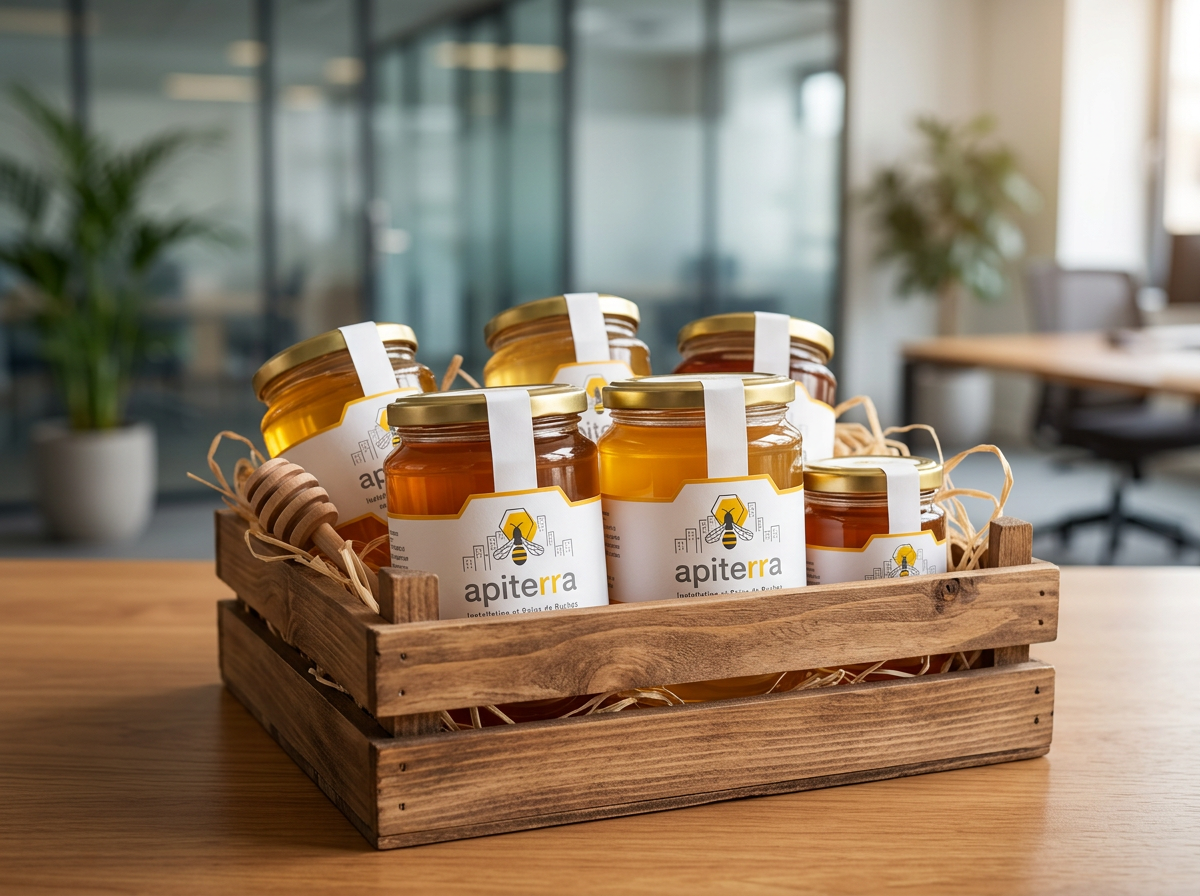
A jar of honey gives the project a tangible expression that can be shared with employees, clients or partners. Apiterra handles the harvest and supplies honey in jars personalised with the company’s logo, with formats including 40 g, 90 g and 150 g.
A hive produces approximately 70 to 200 jars of 150 g, although this is an indicative range rather than a guaranteed yield. Weather, forage availability and colony conditions influence production. The honey is most meaningful when accompanied by the story of the project and the care involved, rather than presented as a generic promotional item or evidence of environmental performance.
Make stakeholder dialogue more participatory
The value of the project need not end with distributing jars. An activity or discussion about bees can offer a welcoming setting for conversations about environmental responsibility. Employees and external stakeholders can ask questions, encounter unfamiliar ideas and explore what responsible action means in practice.
Apiterra’s activities can take place on-site or at its apiaries, allowing businesses to consider different ways of bringing people together. The format should suit the audience and the project’s purpose. A focused learning experience will usually say more about a company’s commitment than a highly branded event with little substantive content.
5. Make a CSR initiative easier to manage and sustain
Reduce the operational burden on internal teams
Many CSR ideas struggle because responsibility is added to teams that already have full workloads. A professionally managed beehive avoids asking employees to become beekeepers. Apiterra’s turnkey service covers the feasibility assessment, installation, regular beekeeping visits, harvesting and delivery of personalised honey jars.
Apiterra also assumes the legal and administrative obligations associated with its service, including insurance, health-record monitoring, DDPP declarations and apiary signage, relieving the client of responsibility for those obligations. The reassurance is practical: a clearly managed project with specialist support, rather than administrative tasks left for the company to navigate alone.
Create continuity through specialist support
Responsible beekeeping requires ongoing attention, not just an installation appointment. Apiterra’s partnership with INRAE and collaboration with a veterinarian specialising in bee pathology provide an expert foundation for its work. Its mobile monitoring and care application adds another dimension to project follow-up.
For the client, an identifiable contact who can be reached in person, with prompt callbacks, helps keep communication straightforward. This continuity matters when internal contacts change or questions arise. Within the company, assigning a project owner remains useful for coordinating communications, employee activities and links with the wider CSR programme.
Choose the Apiterra format that fits your organisation
Host a hive or sponsor one
Hosting a hive creates a direct connection between the project and the workplace, provided the site is suitable. For companies without available space, Apiterra offers sponsorship of hives housed in its own apiaries. This keeps participation open to businesses that cannot accommodate an installation.
The choice should follow practical assessment rather than a preference for visibility alone. Consider the available space, how employees will engage and who will coordinate the initiative internally. Sponsorship is not a second-best option when it better fits the organisation: a well-supported learning programme can be valuable without a hive on company premises.
Work with an established delivery partner
Founded in Angers in 2010, Apiterra moved to Montreuil in 2015, at 19 rue Saint-Just. It works in France, Belgium, Luxembourg and Switzerland, with more than 250 clients, more than 1,000 hives and a presence in over 250 cities. Its clients include Novotel, AXA, Vinci, Legrand and Valeo.
Those facts provide context, but the right project still begins with your organisation’s needs. Discuss feasibility, employee participation, communication materials and the desired level of educational activity. A personalised proposal can then reflect the chosen format rather than treating every site or CSR programme as interchangeable.
Conclusion: make the hive a starting point for lasting action
Combine visibility with substance
A corporate beehive can support five valuable CSR goals: environmental awareness, employee engagement, credible communication, stronger stakeholder relationships and manageable project delivery. Its impact depends less on the installation itself than on what the company builds around it.
The strongest approach combines professional colony care with inclusive activities, proportionate claims and attention to the wider environment. Treat the hive as a platform for learning and participation—not a shortcut to sustainability—and it can become a meaningful part of a long-term CSR programme.
Start with a conversation about feasibility
Apiterra can help you explore an on-site installation or sponsorship in its apiaries, supported by professional beekeeping, employee information and tailored communication options. Begin by defining your objectives and discussing the format best suited to your premises and people.
From there, the project can develop around a clear principle: make environmental responsibility something people can understand, experience and discuss, while leaving the specialist management of the bees to professionals.